So today was lesson one, a more formal version of the last flight allowing me basic controls of the aircraft. A windy but strange day in the air, delayed a bit due to some aircraft troubles (wouldn’t start initially until engineers went to have a look.. when it started fine for them!).
During today’s lesson we headed north over Ashford and performed our exercises over that side of Kent.
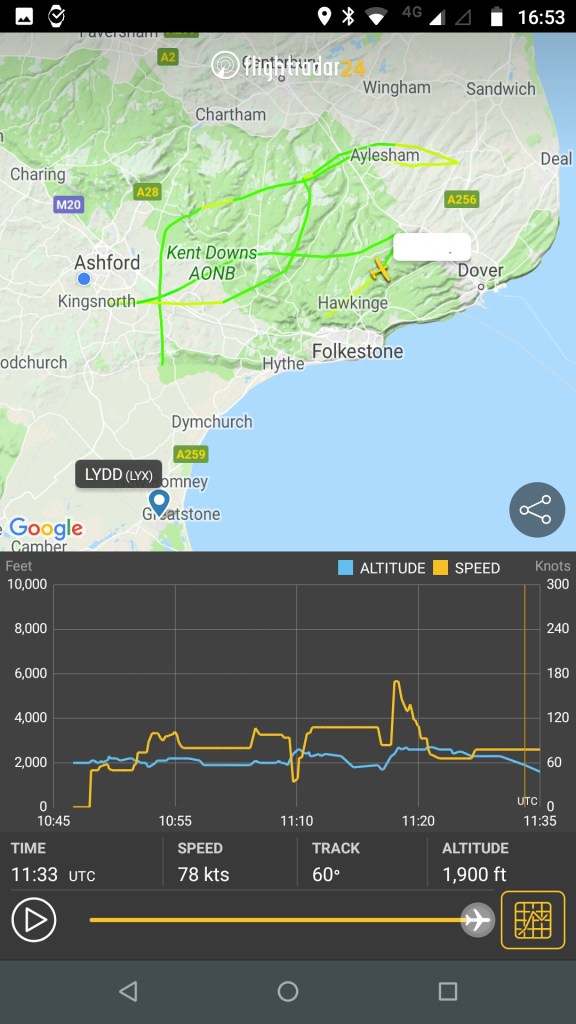
So, since this blog is partly for my own revision purposes.. today’s lesson:
The aircraft turns about 3 axes, all relative to pilot, not outside.
The one most people know about is pitch which is controlled by pulling and pushing the yoke. It does this by adjusting the elevator – two parts of the tailplane of the aircraft. If the yoke is pulled towards you, the elevator angles upwards, causing the plane to pitch upwards. The opposite is also true if you push the yoke causing the plane to pitch downwards.
If the plane is pitched up then it will slow (fighting gravity) and also ascend. Pitched down and the plane will descend and accelerate.
Turning the yoke left and right adjusts the ailerons – the outer adjustable parts of the wing (not to be confused with the flaps towards the inside). This will roll the aircraft left and right. If you turn left, the left aileron will raise and the right lower – lift will reduce on the left and increase on the right, causing the right wing to raise and the aircraft to roll left. Same applies (but other way around) when turning right. As a secondary effect, the aircraft will also yaw causing a spiral descent if uncorrected.
Third primary control is the rudder – a vertical part of the tailplane. This is controlled by your feet and will cause the plane to yaw (turn) left or right. It also (to a lesser degree) roll the aircraft.
These three controls combine to control the movement of the aircraft.
To maintain a level flight (testable by taking hand off controls) once pitch is level and speed is comfortable (90kts in the C152), the trim control adjusts smaller flaps on the elevators. Adjust until the yoke is no longer resisting or pushing back.
The throttle controls the rpm of the propeller, more rpm (push in) and the aircraft will accelerate but also pitch upwards. Also vice versa. The aircraft will in time naturally level out at the increased speed, but any changes may require retrimming.
And that concludes the majority of today. Next time some more practice with the controls and attempting to keep the aircraft in a straight and level flight.
I’ve also now got a checklist for the aircraft for preflight checks and book 2 to start on – the big subject: air law. Lots of learning the rules of the sky!

 The Word of Rob